
Stone Oak Park
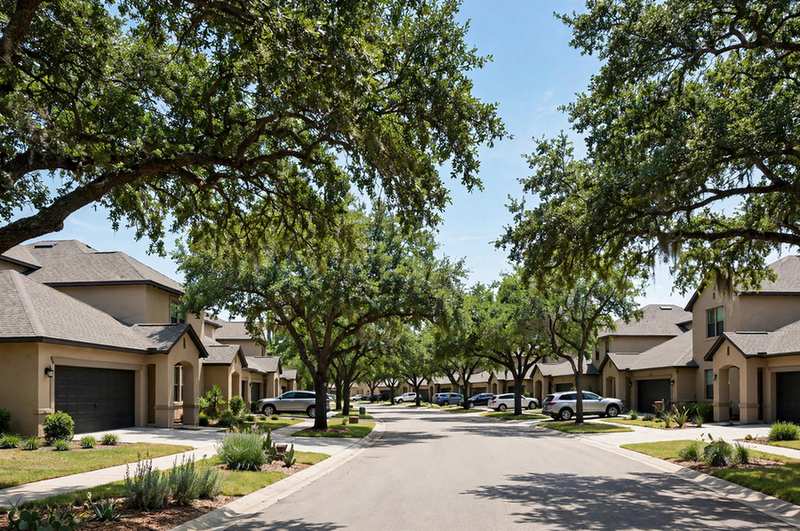
Stone Oak Park sits near the centre of the Stone Oak footprint and is a useful orientation point for the surrounding residential streets.

Most of the housing stock in Stone Oak went up from the 1990s onward, which means a large share of original architectural-shingle roofs are reaching the end of their realistic 15 to 20 year life at the same time, while the tile roofs are reaching the end of their underlayment's 20 to 30 year life. Stone Oak is tile-heavy and architectural-shingle-heavy, with many homes designed for tile after 1980, and HOAs commonly require pre-approval of roofing material, colour, and style, so we get the approval in writing naming the exact product and colour before ordering material. The city median year built is 1985, and Stone Oak's stock is younger than that, which is why the work here is mostly first and second replacements rather than third. Hail is the other driver: about 85 percent of Bexar County hail reports of one inch or more fall in March through May.
Sonterra is a master-planned community in the Stone Oak area along Sonterra Boulevard, built in the 1999 to 2005 window, with two-story tile and architectural-shingle homes and HOA architectural review.
Roofs from the Sonterra build era are reaching replacement age together, which is why the work here is mostly first replacements on original shingle roofs and underlayment work on tile roofs. If your home is in Sonterra, call (254) 645-5833 to schedule an inspection and we will check the roof's age against its material.
Stone Oak roofs are mostly tile and architectural shingle on two-story homes, with HOA review in front of every job. These are the four services we use most here.
Stone Oak roofs face hail, heat, and HOA rules. These are the four problems we see most.
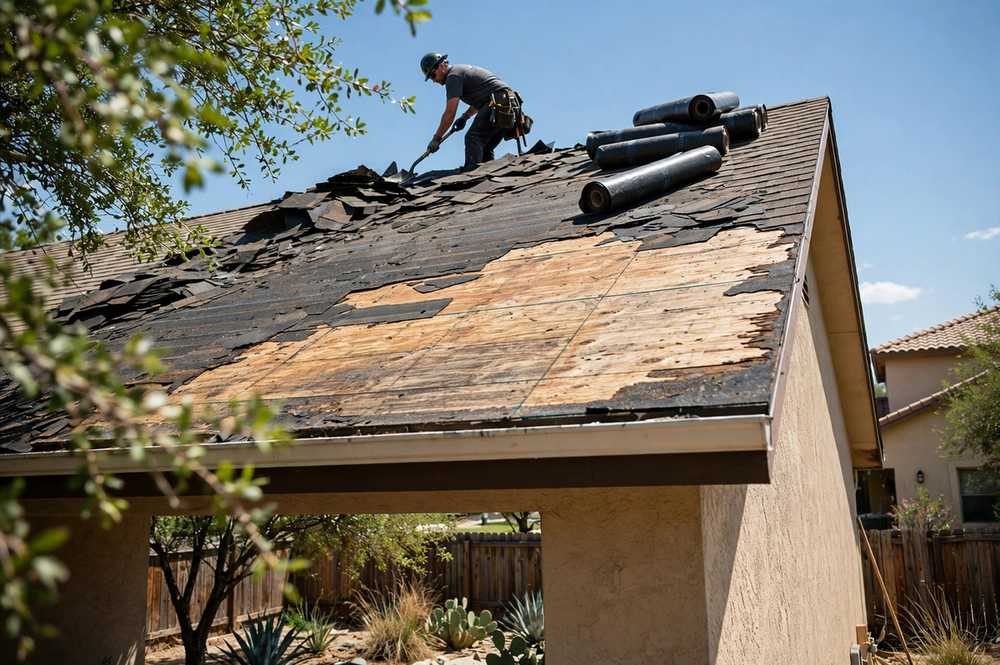
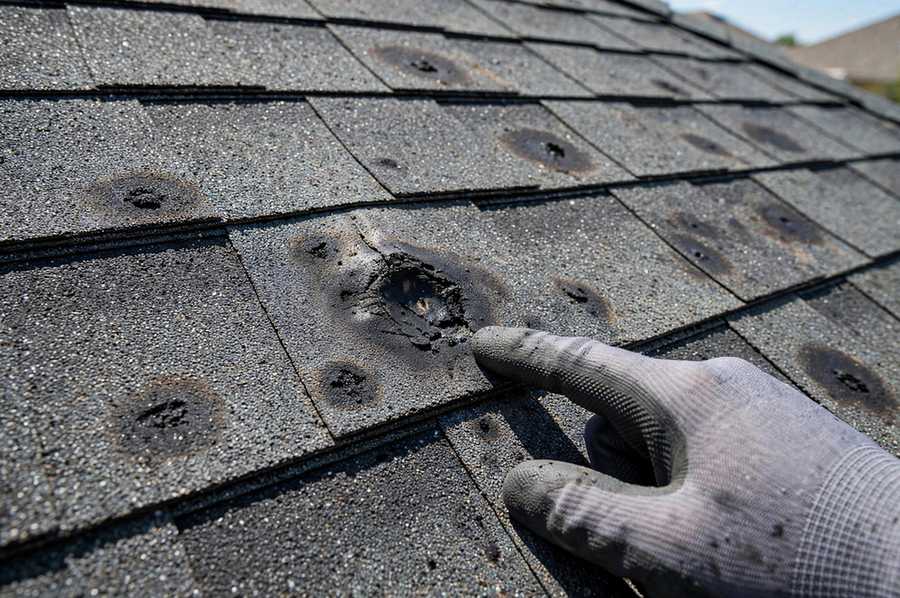
Bexar County hail storms drop stones that knock granules loose and bruise the shingle mat. On roofs over 15 years old, the mat is already brittle, so hail damage shortens what is left of its life.
Tile can last 50 years or more, but the underlayment beneath it lasts 20 to 30 years. On a Stone Oak tile roof, the leak usually means the underlayment has given out, not the tile.
Texas heat cycles expand and contract metal flashing until the sealant cracks. Most Stone Oak leaks we trace start at a flashing point, not in the shingle field.
Wind off the Hill Country can lift shingle tabs and tear ridge caps, especially where older sealant has lost adhesion. We reseal or replace the affected courses and check the ridges and hips.
Stone Oak roofs do not always fail loudly. If you are seeing any of these, it is worth getting an inspection before the next storm season.
Granules collecting in gutters and downspouts
Granule loss is normal as shingles age, but a heavy accumulation after a hail storm means the shingle mat is exposed and will degrade faster.
Ceiling stains or water marks after rain
A brown ring on the ceiling usually means water is getting in at a flashing point or a failed shingle. The leak may be several feet from the stain, so we trace it before repairing.
Missing or lifted shingles after a storm
Wind can lift shingle tabs without tearing them off completely, which leaves the roof open to the next rain. We reseal lifted tabs, replace missing shingles, and check the rest of the roof.
Sagging roofline or soft spots on the deck
A sagging roofline usually means the decking or framing has water damage. We inspect the attic side and the decking before recommending repair or replacement.
Daylight visible through the roof boards in the attic
If you can see daylight through the roof deck, there is a gap or a failed penetration that will leak. This is common around chimneys and skylights in Stone Oak homes.
Stone Oak runs along US 281 and Loop 1604 in the far north. These are the reference points our crews use when routing to the area.
Stone Oak Park sits near the centre of the Stone Oak footprint and is a useful orientation point for the surrounding residential streets.
Sonterra Golf Club is a recognisable landmark for locating the Sonterra residential streets and the surrounding communities.
Hardy Oak Elementary is a familiar reference point for the northern Stone Oak subdivisions and helps our crews route efficiently to nearby homes.
North Central Baptist Hospital anchors the medical district along the 281 corridor and is a reference point for addresses in the surrounding area.
Our office is at 6 Irongate Creek, San Antonio, TX 78238. Call to ask whether your address is in our current service area.
5.0 out of 5 from 18 Google reviews.
"Rene took a genuine, zero-pressure approach. He is remarkably honest, transparent, and truly puts the customer's best interest first."
Imanii Roberson
Roof repair for storm and wind damage · 2 months ago
"He was so professional, walked me through the steps of how to make a claim with my insurance, and the whole process was super simple. The roof was installed in just one day, and the crew was incredibly clean and professional."
Donnovan Smith
Storm and wind repair, roof installation · 2 months ago
Stone Oak weather follows the citywide pattern: spring hail, summer heat, and a mild winter. Here is what each season means for a far-north roof.
Spring is hail season in Bexar County. About 85 percent of hail reports of one inch or more fall in March through May, and the 12 April 2016 storm dropped 4.5-inch stones across the city. We see a surge of calls for missing shingles, hail damage, and leaks after each storm line.
Tip: Get a roof inspection after any hail storm, even if you see no damage from the ground. Granule loss and bruising are not always visible.
Summer heat bakes shingles and sealant, and attic temperatures climb well above the outdoor air. UV exposure ages roofs faster, and afternoon thunderstorms can dump heavy rain in a short time, testing every flashing point.
Tip: Schedule maintenance in early summer to reseal flashing and clear debris before the afternoon storms start.
Fall brings another round of storm lines with wind and hail, plus falling leaves that collect in gutters and valleys. We see a lot of wind-lifted shingles and gutter backups in October and November.
Tip: Clear gutters after the leaves drop and check for lifted shingles after any wind event. Fall is also a good time to plan a replacement before the holidays.
Winter in Stone Oak is mild, but an occasional freeze can crack flashing seals. We see fewer calls, but the ones we get are often leaks that started at a flashing point.
Tip: Check attic insulation and ventilation before the first freeze. If you see icicles at the roof edge, that is a sign of heat loss and poor ventilation.
Stone Oak sits in the far north, close to the other master-planned communities. These are the nearby San Antonio neighbourhoods we also serve.
(San Antonio neighbourhood)
Far-north master-planned homes along Bulverde Road, tile and shingle.
View Encino Park(San Antonio neighbourhood)
Northeast neighbourhood built around 1985 to 1989, on second and third roofs.
View Thousand Oaks(San Antonio neighbourhood)
Gated master-planned community inside San Antonio, with tile-heavy estate roofs.
View The Dominion(San Antonio neighbourhood)
Far-west master-planned homes with newer large-format shingle roofs.
View Westover HillsReal answers from our team for the questions we hear most often before a job starts.
If your Stone Oak roof is leaking, missing shingles, or old enough that you are not sure it will make it through the next hail season, call us. We will inspect it, tell you what it needs, and give you an estimate before any work starts. Call (254) 645-5833, Monday to Saturday, 6 AM to 8 PM.
Call us at (254) 645-5833 or send a message and we will get back to you. We serve Stone Oak and Sonterra, including the 78258 area for Stone Oak.
Phone
(254) 645-5833Address
6 Irongate Creek, San Antonio, TX 78238, United States, San Antonio, Texas
Hours
Mon–Sat: 6 AM – 8 PM
Sun: Closed