
Full tear-off and disposal
Every layer comes off down to the deck, and every layer leaves the property. A roof already carrying two layers cannot take another, so the tear-off is where the next twenty years of the roof are decided.
Residential roofing here is not one roof type repeated across the city. A 1950s ranch inside Loop 410, a steep bungalow near downtown and a two-story in the far north each fail in different places, so the job is scoped to the house, not to a package.
Every layer comes off down to the deck, and every layer leaves the property. A roof already carrying two layers cannot take another, so the tear-off is where the next twenty years of the roof are decided.
Decking that is soft, rotted or delaminated is cut out and replaced before anything new goes down, and you see the bad sheets before they are covered.
Underlayment, flashing, drip edge and pipe boots go on as one system, because a new finish over old flashing is the most common way a new roof starts leaking.
Intake at the soffit and exhaust at the ridge are checked together. In a city with more than a hundred days a year above 90 degrees, an attic that cannot breathe ages the shingles from below.
We walk the finished roof with you, photograph the flashing and ridge details, and leave you with a written record of what was installed and what to watch.
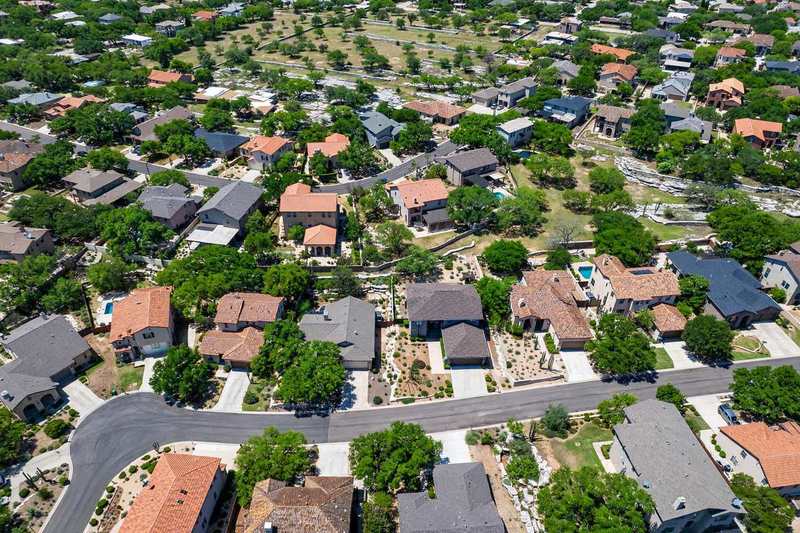
Most San Antonio homes were built before 2000, and the citywide median year built is 1985. That means the typical residential roof in this city is not a first roof: it is a replacement timed by the age of the subdivision, the material on the street and the hail seasons it has already survived.
That is why a roof inspection comes before any recommendation. We look at every slope, the attic side of the deck, the flashing at chimneys and walls, and the ventilation. Then we tell you plainly whether a repair will hold, whether the roof is near the end of its life, or whether a replacement is the honest answer. You decide from a written scope, not a sales pitch.
Here is how a residential roofing job runs, from the first call to the last walk-through, so you know what happens on each day and who is on your roof.
Schedule
Call (254) 645-5833 during hours and tell us what you are seeing: the stain, the granules in the gutter, the age of the roof. We set a time to look at it, and we look at the whole roof, not just the spot that worries you.
Diagnose
We inspect every slope, photograph the wear and the flashing, and check the attic side of the deck. The photos are yours to keep, and they are the basis for everything that follows.
Fix
You get a written scope for the work your roof actually needs, with the material and the flashing work named, so the decision in front of you is specific instead of general.
Finish
We finish the work, photograph the details, sweep the yard with magnets, and walk the finished roof with you before we leave.
Roofing nail gun
On a residential roof the nail gun sets every fastener to the same depth, which matters when a shingle has to hold through a squall line and the next hail season.
Moisture meter
The moisture meter reads the deck before we trust our eyes. A sheet that looks dry from above can be damp underneath, and that is the sheet that fails first.
Chalk line and shingle cutter
A chalk line and a shingle cutter keep every course straight and every cut clean, so the finish sheds water the way the pattern intends instead of fighting it.
Pry bar and roofing hammer
The pry bar and roofing hammer open up the layers a repair has to reach, showing us the deck and the old flashing before we decide what stays and what goes.
Safety harness and roofing ladder
A harness and a roofing ladder are how the steep slopes get worked safely, because a rushed footing on a 10-pitch bungalow is how a good job turns into a bad day.
Full tear-off, no layering
Full tear-off, no layering: a roof that already carries two layers gets stripped to the deck, because the city's two-layer limit is a hard stop, not a suggestion.
Manufacturer-spec nailing pattern
The nailing pattern follows the material maker's pattern for this wind zone, with the fastener count and placement the pattern calls for at 108 mph design wind.
New flashing at every penetration
New flashing goes in at every penetration, chimney, wall and valley, because flashing is where most residential roofs fail, and old flashing under a new finish is a leak waiting for rain.
Balanced ventilation check
The ventilation check balances intake and exhaust, so the attic moves air instead of storing heat above the rooms you live in.
01
What we do: We walk the roof slope by slope, check the granule loss against the age of the shingles, and look in the attic to see whether the heat has been cooking the mat from below.
The homeowner gets a written scope for the residential roofing work, with photos of the worn slopes and a clear statement of what a repair can still do and what it cannot.
02
What we do: We photograph the stain from the attic side, trace the water back to its entry point, and check the slopes above the stain before we name the fix.
The roof is documented, the residential roofing work is scoped, and the homeowner decides with the evidence in hand rather than a guess.
03
What we do: We measure the remaining life plainly: granule loss, curling, bruising, and the age of the roof against the 15-to-20-year life architectural shingles commonly get in this heat.
The residential roofing work is done in the open, with photos before and after, and the report is written so a buyer and their inspector can read it without a translation.
04
What we do: We compare the cost of another repair against the age of the roof, and we say plainly when a 14-year-old roof has more repairs ahead of it than behind it.
The homeowner keeps photos of the damage and a written scope for the residential roofing work, so the next step is a decision, not a guess.
San Antonio roofs take a specific beating: spring hail, summer heat that cooks shingles and attics, and clay soils that shift under the slab. We build for all three, and we plan the work around the neighbourhood the house stands in.
Stone Oak
Stone Oak's master-planned streets are 1990s and newer, so the roofs there are often on their first replacement, with tile-heavy streets beside architectural shingle ones and HOA rules that name the material and the colour.
Monte Vista
Monte Vista's early-20th-century houses carry steep, complex roofs under mature live oaks, and many sit in a historic district, so the material and the profile are reviewed before the work starts.
Thousand Oaks
Thousand Oaks dates to the 1980s, which puts its roofs on their second or third covering now, with the 15-to-20-year shingle life doing the arithmetic.
Westover Hills
Westover Hills is far-west master-planned building from the 1990s onward, where newer large-format shingle roofs are reaching their first replacement window.
Spring hail season across Bexar County
Spring hail season across Bexar County runs March through May, when about 85 percent of the large-hail reports fall, and the plan for your roof is written with that calendar in mind.
Summer UV and 100-degree heat
Summer UV and 100-degree heat ages shingles from above and below, granule loss first on the south and west slopes, and the ventilation check is part of the scope, not an afterthought.
Live-oak debris in valleys
Live-oak debris in valleys holds water against the shingles, and the late-February-to-March leaf and catkin fall is the moment to clear them before the spring storms.
Most roofs do not fail all at once. They fail at a flashing detail, a cracked boot, or a slope that lost its granules, and the damage spreads from the detail outward, which is why the first look is always at the details.
Problem
Ceiling stains after a hard rain usually mean water has been travelling along the deck for a while before it found a place to drip, so the stain marks the exit, not the entry.
Our Fix
We trace the stain back to the entry point, fix the cause of the ceiling stains after a hard rain, and photograph the repair so you can see where the water was getting in.
Problem
Missing or lifted shingles after wind leave the underlayment exposed to the next rain, and a single bare patch can wet the decking underneath in one storm.
Our Fix
The fix for missing or lifted shingles after wind starts with the lifted tabs around the bare patch, because wind damage spreads outward from the first loose shingle.
Problem
Hail bruises that are not leaking yet still break the shingle mat, and the granule loss that follows lets UV at the asphalt, which is how a bruise becomes a leak a season or two later.
Our Fix
We document hail bruises that are not leaking yet slope by slope, so the scope names the damage while it is still small and the photos show what the ground cannot.
Problem
Algae streaks and dark staining are most visible on the north slope, where shade holds moisture, and they usually travel with granule loss on the south and west slopes.
Our Fix
We fix the cause of the algae streaks and dark staining by addressing the worn slopes, not by washing the roof, because the streaks are a symptom of an ageing mat.
Problem
Water backing under the roof edge happens when the drainage path is blocked or the edge flashing has failed, and it wets the deck from below instead of above.
Our Fix
The fix for water backing under the roof edge is to open the drainage path and repair the edge flashing, then check the deck underneath for soft spots before the finish goes back on.
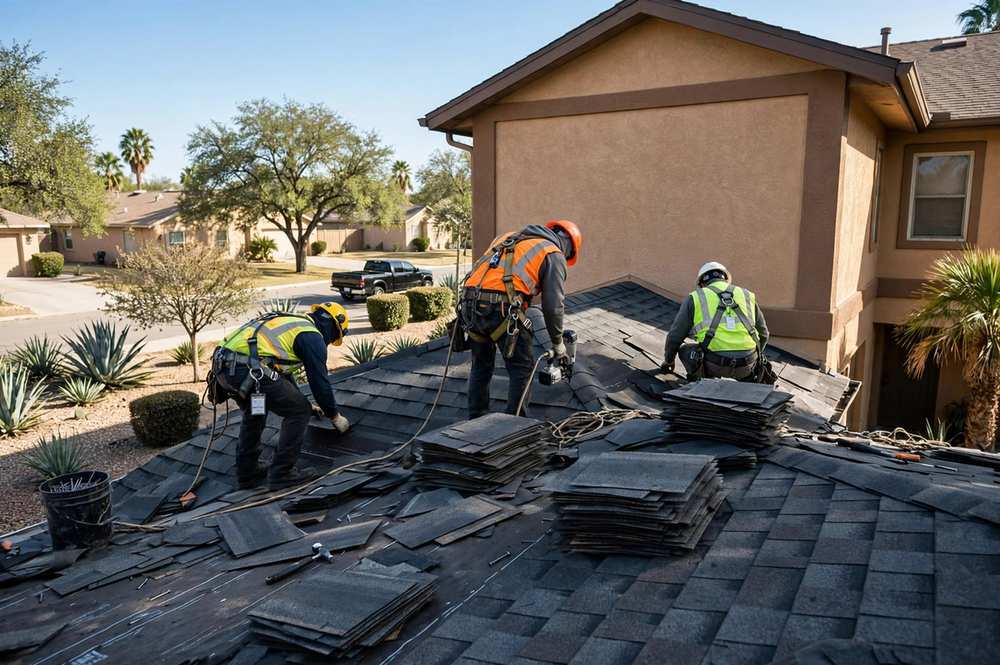
Patching buys a season. A full replacement, done with new flashing and balanced ventilation, gives the house a roof that can face the next hail season and the next hot summer. See how architectural shingles hold up here, or compare metal roofing if you want a longer-lived option.
A roof built for hail season
A roof built for hail season is built into the residential roofing work, not added on top of it: the nailing pattern, the underlayment and the flashing are all chosen for a city where April brings the hail.
Cooler attics in August
With residential roofing, cooler attics in August are the difference between shingles that last their years and shingles that curl early, which is why intake and exhaust are balanced on every job.
Flashing replaced, not reused
Flashing replaced, not reused is one of the reasons homeowners choose our residential roofing work, because the flashing is the part that fails first and the part a shortcut leaves behind.
A clean yard when we leave
A clean yard when we leave is built into the residential roofing work, not added on top of it: the debris is hauled off and the yard is magnet-swept before the walk-through.
Kbron Roofing holds 5.0 out of 5 from 18 Google reviews, all 5-star. Reviewers name Rene Vargas as their contact and describe honest, no-pressure service. Read short verbatim excerpts from those reviews in the Residential Roofing testimonials below.
We work on the housing stock Bexar County actually has, from 1920s bungalows to new construction, and we put our name and address on the work: Kbron Roofing, 6 Irongate Creek, San Antonio, TX 78238. Call (254) 645-5833 and talk to a real person during hours.
Short verbatim excerpts from Google reviews by customers who chose our residential roofing work. All five readable reviewers gave 5 stars two months ago; three are quoted below.
"Rene took a genuine, zero-pressure approach. He is remarkably honest, transparent, and truly puts the customer's best interest first."
Imanii Roberson
★★★★★ · Homeowner, San Antonio · 2 months ago · Roof repair for storm and wind damage
"Rene is incredibly honest, hardworking, and dedicated to his customers. He takes the time to truly understand your needs and delivers quality work and results at a price that won't break your wallet."
Joe Favor
★★★★★ · Homeowner, San Antonio · 2 months ago · Roof inspection, roof installation, storm and wind repair
"He was so professional, walked me through the steps of how to make a claim with my insurance, and the whole process was super simple. The roof was installed in just one day, and the crew was incredibly clean and professional."
Donnovan Smith
★★★★★ · Homeowner, San Antonio · 2 months ago · Storm and wind repair, roof installation
Real answers to the questions we hear most often about residential roofing in San Antonio, written from the roofs we actually work on.
Roof Replacement pairs with residential roofing on many San Antonio homes, and the two scopes are written together so nothing is missed.
View Roof ReplacementWhere residential roofing work raises a question, roof repair is often the answer, and we scope it in the same visit.
View Roof RepairRoof Inspection is the natural next step after residential roofing on a roof that needs more than one kind of attention.
View Roof InspectionShingle Roofing pairs with residential roofing on many San Antonio homes, and the two scopes are written together so nothing is missed.
View Shingle RoofingWhere residential roofing work raises a question, roof maintenance is often the answer, and we scope it in the same visit.
View Roof MaintenanceTile Roofing is the natural next step after residential roofing on a roof that needs more than one kind of attention.
View Tile RoofingCall us at (254) 645-5833 or send a message and we will get back to you during business hours. We schedule residential roofing visits Monday to Saturday, 6 AM to 8 PM.
Phone
(254) 645-5833Address
6 Irongate Creek, San Antonio, TX 78238, United States, San Antonio, Texas
Hours
Mon–Sat: 6 AM – 8 PM